
Your bottling line runs below what it can do: where the fix is hiding
 Paschalis KosmidisMSc Mechanical Engineer, AUTh7 min read
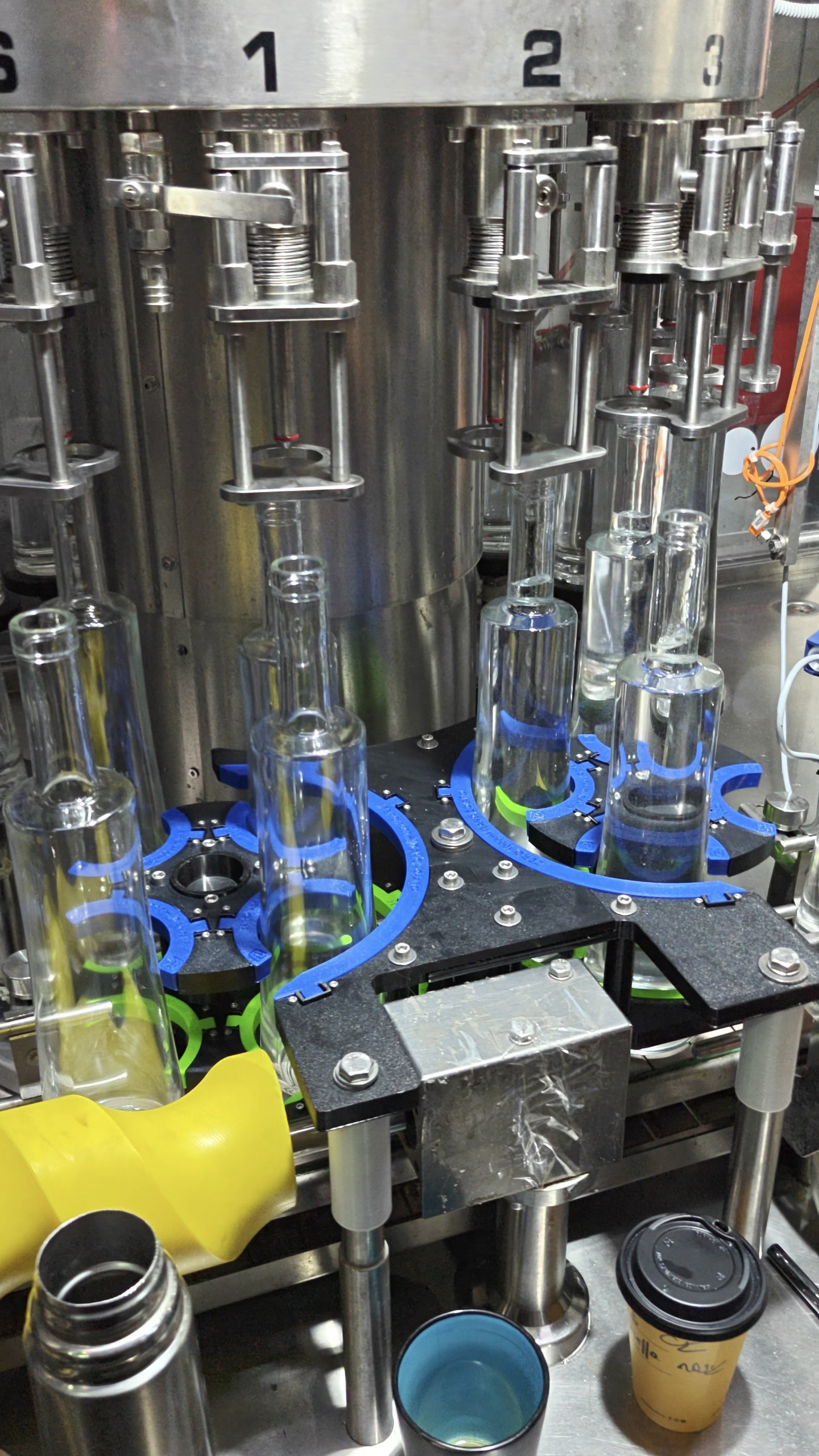
The machine has a speed on its nameplate. Your line runs slower. And every time you push it up, something stops.
In this guide
Most people think the machine is to blame. Usually it is not. The fix hides in two places. In the machine settings, and in how well the parts adapt to the irregularities of the bottles.
No bottle is identical to the one next to it. The diameter depends on the mould. In practice, though, we see that it also depends on the shape, the supplier, even the batch. It ranges from ±1 mm up to ±3 mm in extreme cases. A part made only for the "nominal" bottle will struggle with the rest.
- Low output usually means settings or parts, not a bad machine.
- The parts have to absorb the differences between bottles.
- Start with a check, not with a purchase.
What low output looks like
- you run the line slower than the speed the machine can do,
- you have small stops that are never logged but eat up the day,
- someone is always standing over it,
- with one bottle the line runs well, with another it does not.
The last one is a sign that the line has no repeatability. That is a problem in itself. It is worth solving.
The signs also show in the finished product:
Labels
Crooked or creased, at different speeds.
Batch number
Missing. It makes later review harder.
Fill level
Not consistent, at the filler outlet and in the finished product. This is a very big problem, and it usually comes down to the sealing rubbers on the filling nozzles.
Closures
"Bitten" caps, or defective closures in general.
Keep in mind that a set that runs perfectly with one sample bottle can fail when a whole line of bottles pushes together. We once had a set 2-3 mm tighter than a conventional star wheel: with one bottle it ran, with a full line the machine stopped 5-6 times.
First, the machine settings
Before you change any part, check the settings. They cost nothing.
Height at each station
Every station has to be set to the right height. But at each station, height controls something different.
Rinser
The grippers have to hold the bottle well, without leaving it room to wobble. Bottles usually wobble because of the bulge at the neck. The grippers usually have a recess for it, so the bulge has to sit inside the recess. If they do not, they have to grip it from below or from above.
Filler
It has to leave enough room for the bottles to pass, but not too much. Otherwise the bottle is not pressed properly against the seal and does not fill reliably.
Capper / corker
Here too height matters for the pressure, especially with Stelvin screw caps and corks.
Capsule station
It matters if you want to raise the speed.
Labeller
This one has many dimensions and needs a technician to study it.
Guides
If they are too tight, you get jams. If they are too loose, the movements lose their consistency. Either way you cannot run at the speed you want, and you risk damage. Especially if they are too loose.
The other settings
- infeed screw timing with the star wheels,
- capsule station adjustment,
- labeller height and timing, especially with two labels, front and back,
- centring on the closure,
- conveyor speed,
- vacuum in the filler bowl, if the machine works under vacuum.
A slow-motion video helps a lot. Film the spot for 10-15 seconds, long enough for 6-7 bottles to pass, and watch it back slowly. Two times out of three, that is enough to find the cause.
Then the parts: how well they adapt to the bottle
Our grippers: a shape that absorbs the differences
Bottleneck grippers work as a compliant mechanism. They have no spring in the usual sense. It is the shape of the gripper itself that lets it absorb the irregularities of the bottles.
If a thicker bottle comes, the gripper absorbs its volume. So it can be made closer to the nominal diameter. And when a thinner one comes, it is not too loose and causes no problem. It absorbs differences of up to ±2 mm in diameter.
What you gain in practice:
- more adaptability,
- fewer jams,
- minimal play in the movements,
- you can bottle even faulty batches, the ones you only discover after you have started,
- control over wear, and easy replacement when the time comes.
We have customers who, after fitting the Bottleneck system, gained so much freedom that they now do a lot of private label work. They opened a new market.
Centring bells
Centring bells are usually not the cause. They are a symptom. When they are worn, they tell you the machine is not working properly: the bottles do not arrive centred in the first place. That can come from a bad star wheel, a bad setting, wear or the wrong bottle. It can also come from misuse, for example settings changed by an operator.
If the centring bells are damaged, the machine is at risk of serious damage.
Silicone rubbers
You find them mainly in the filler and the capper. In the filler they are the sealing rubbers on the nozzles. When the fill level is not the same in every bottle, these are usually the cause.
Infeed screws
The infeed screw is easy to adjust and usually does not need replacing. By moving it forward or back, together with the guide, it can take most bottles of the same volume. Sometimes one size down or up as well (for example 500 ml, 750 ml and 1000 ml).
What to do next
- 1
Film the spot where it stops, in slow motion.
- 2
Check the settings: height, guides, timing, infeed screw.
- 3
Test with many bottles from the real batch, not with one.
- 4
If you cannot find the cause, send us the video, the machine model and the bottle diameter.
If it is a setting, we will tell you. If you need new star wheels, we will tell you that too, and we will discuss what makes sense for you, based on your production.
When it is not worth it
- When the line already runs close to the machine's limit.
- When the bottleneck is somewhere else: labelling, palletising, staff.
- When the new bottle is a one-off and you do not plan to bring in another new one. Then it is worth bottling it by hand.
Frequently asked questions
Why doesn't my line reach the machine's rated speed?
Usually it is the settings, or parts that cannot adapt to the differences between bottles. Start with a slow-motion video of the spot where it stops.
How much do bottles differ from each other?
From ±1 mm up to ±3 mm in extreme cases. It depends on the mould, the shape, the supplier, even the batch.
What does the "spring" in your grippers do?
It is not a spring in the usual sense. It is the shape of the gripper (a compliant mechanism) that absorbs differences of up to ±2 mm in diameter. So the line holds both thicker and thinner bottles steady.
Why is the fill level not the same in every bottle?
Usually the sealing rubbers on the filler nozzles, or the filler height: if it leaves too much room, the bottle is not pressed properly against the seal.
Do I need a new machine to get more output?
Usually not. Check the settings and the parts first. I can't tell without seeing it, but a video is usually enough for us to say what it looks like.
Want us to look at your own line?
Book a free 30-minute call, or send us a message. There is no commitment.